Tuesday, August 8, 2017

Eclipse Eye Safety Update


I wanted to give an update to my eclipse eye safety post from earlier:

There are rumors of unsafe eclipse glasses and viewers being sold. Your best bet is to get one that is made by an approved manufacturer, or one of its distributors. 

Here are some articles of interest:

and
 
Don’t forget that you can also view through a #14 welder's filter that is  glass or polycarbonate WITH gold coating.

All of the above are assuming that you are viewing with just your eyes. If you are viewing with magnification, see: https://eclipse.aas.org/eye-safety/optics-filters or contact me at eclipseaugust2017@gmail.com
 
Of course, you can always project the Sun’s image: https://eclipse.aas.org/eye-safety/projection
 
If you are in that totality path, then the totality (only!) is safe to look at without protection.

Safe viewing!

Sunday, August 6, 2017

Reading- and dealing with- the weather

The last few posts have dealt with traffic issues, getting to the eclipse path, and escaping from the clouds. Now, we pull these topics all together and help you learn about how to read the weather in the days leading up to, and including, eclipse day.

Links (with some explanations):

(all links with eclipsophile in them are courtesy of Jay Anderson, former meteorologist with Environment Canada)

http://eclipsophile.com/real-time-weather/ - this one is a quick links site, useful for quick loading on eclipse day)

http://eclipsophile.com/eclipsewx/ - basically the same links as the above (and a few more), just with explanations on how to use them. Good to study well before eclipse day.

From Jay, as posted to the eclipse chasers discussion group: “I draw your attention to spotwx.com, which provides site-specific graphical forecasts – click on a map or type in a community name (or lat/long) and you will get access to up to a half-dozen Canadian and US computer models for the site. You can easily compare the models to see how they agree ahead of the magic day (up to 10 days out). For areal forecasts, you can look at SkippySky or the College of DuPage (which has access to several models, great satellite coverage, and is my favourite storm-chase resource). Both CoD and spotwx offer ensemble forecast outputs; these are created by running a model many times with slightly different starting conditions to give a range of values for the outputs: temperature, dewpoint, cloud cover, wind and so on.”

Also, as you’re looking at cloud cover percentage forecasts, such as the ones on http://www.skippysky.com.au/NorthAmerica/ and http://clearoutside.com/ (linked in the above, under “numerical forecasts”)- that cloud cover  percentage could mean different things (using 50% as an example):

1.    That one side of the sky is completely clear, and the other side of the sky is overcast or mostly cloudy. If the side of the sky that is clear is where the sun will be at eclipse time, then you may be in good shape. Watch the timing of that forecast, though- it could mean that the overcast is moving in! Here are the approximate directions and altitudes of the sun, during totality, from different locations:

·       Oregon/Idaho: 45-50 degrees up in the E/SE

·       Wyoming/Nebraska: 55-60 degrees up in the S/SE

·       Kansas/Missouri/Illinois: 60-65 degrees up in the South

·       Tennessee/Georgia/North and South Carolina: 60 degrees up in the south

2.    It could also mean that the clouds are covering the sky in all directions, but the clouds are likely small and scattered.

3.    You may have scattered clouds in one area of the sky, but perhaps a thunderstorm or 2 in another part of the sky. ­

Articles (also by Jay Anderson):

 
http://www.kasonline.org/primefocus/2017/PF0817.pdf (weather article starts on page 14, but the other articles are interesting too!)

Reading satellite photos; identifying types of clouds:

See https://cimss.ssec.wisc.edu/satmet/modules/4_clouds/clouds-1.html#tag on how to read satellite photos and learn about how different types of clouds appear on them. See http://www.metoffice.gov.uk/learning/clouds/cloud-spotting-guide for more on identifying clouds.

Please note that most of the types of clouds on the metoffice link above will moderately to significantly degrade the view if they are in front of the Sun during totality. The exception to this is cirrus clouds- interference from them may be slight- but ONLY if they are very thin and wispy.

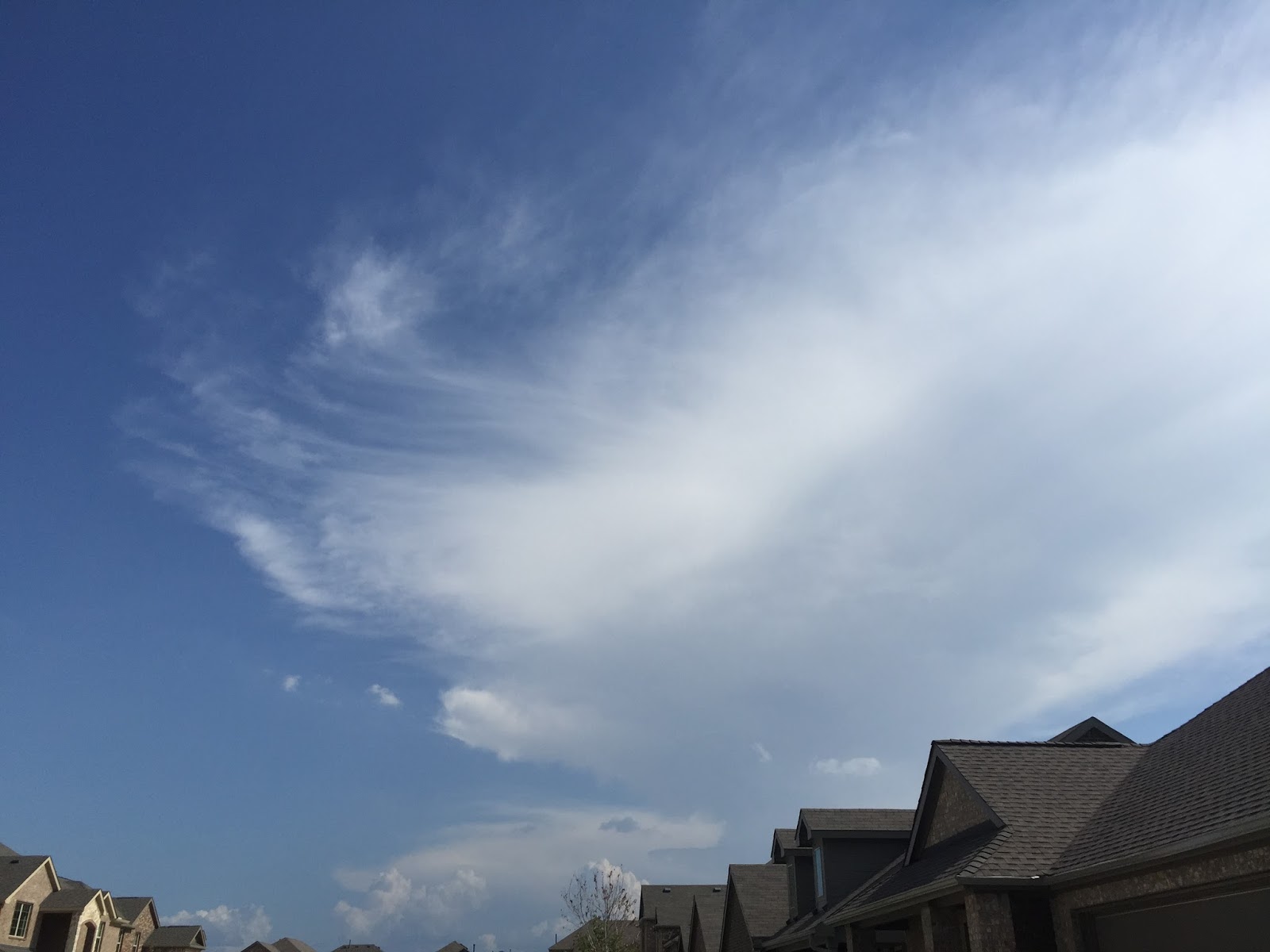
Of special note: fair weather cumulus clouds have a good chance to dissipate- partially or completely- before totality. These clouds look like popcorn, both from the ground and on the satellite photos. See the image below, for example. These types of clouds need heat to form, so the temperature drop helps. This assumes that there aren’t too many of them, and that the clouds have not built up to the point that they are producing precipitation. For example, I would think that most of the clouds in the image below would dissipate, but not necessarily all of them.
From Jay: “Typically, small convective clouds with their “roots” on the ground will dissipate as the shadow approaches as the ground cools far more than the atmosphere and their forcing is cut off.” 

Of course, if the clouds have built up to point that they are causing precipitation, then you'll want to avoid those- they are not likely to dissipate. See this image:


You'll want to avoid the main body of the storm (of course!) but also the thick cirrus (anvil) that blows out ahead of the storm. These will show up as bright white on satellite photos (see slide 8 on the cimms link above). Also note from the picture that each storm may be rather small: unless the storms have merged together, you may only need to drive about 20-30 miles to get the sun in the clear. Remember, though, don't drive yourself outside of that totality path: make sure you have detailed digital- and print- maps! 

There is a concern about clouds forming as the temperature drops- the most common is stratus, and fog. If stratus or fog is in your area as the eclipse begins, but starts to go away during the partial phases, it may reform as you get closer to totality. This is especially worrisome on the Oregon coast. Timing is important. From Jay: “Fog may reform if it is only a short time elapsed since it first dissipated (Baja 1991 but not Egypt 2006). If an hour or two has passed, the moisture is likely distributed through a greater depth of the atmosphere and will not reform in the duration of an eclipse. Of course, if a persistent fog bank lies nearby (offshore?), all bets are off.” 

Remember that local topography can play a role in influencing cloud cover. More from Jay: “Having said that, convective clouds of sufficient depth or amount (broken cloudiness) may also spread out into a layer of stratus, though I think that is more likely in mountain environments (i.e. 1988 in the Philippines, 1991 in Baja (see http://astropix.com/html/l_story/baja91.html - courtesy of Jerry Lodriguss).” (do note that both of those mountain ranges are surrounded by water- lots of moisture available.) A mountain range does not have to be very tall or large in size to produce local cloud cover.

Also, broad valleys can possibly reduce cloud cover, if you are on the leeward side of a mountain range. This is assuming that a frontal system or low pressure system is not over that area.

Speaking of that, you’re mainly trying to avoid cold and warm fronts, low pressure systems, and storms. The mid and high level clouds associated with weather systems are generally unaffected by eclipse cooling.

Smoke

If you are under the smoke from a forest or grass fire, your view of the eclipsed sun during totality will be compromised. The farther you are away from the thickest smoke, the less the interference. If you are under thick smoke, the corona may be seen as a pinkish color (it is normally whitish). Of course, if you're that close to the thickest smoke, then your safety may be a concern. See the "forest fires and smoke" links on the eclipsophile sites above.

Summary

The key phrase is: be as flexible to moving as you can reasonably and safely be. Take a look at these links and tips (and the last few posts here.) The final decision on what you will do on eclipse day will come on that day, or maybe the day before, but NOW is the time to discuss with your group what you may possibly do in these scenarios (both long range and short range).

Of course, I hope the entire totality path is clear and that writing this has been a complete waste of time!

Thursday, August 3, 2017

Dealing with the traffic


This is one of the trickier posts that I’m making. I’m giving my opinions on how to deal with the very heavy traffic that is likely to be happening in certain areas along the eclipse totality path.

I’ll start by linking to Michael Zeiler's site: https://www.greatamericaneclipse.com/statistics/
 
He has used software to estimate the crowds that may go see the eclipse. He estimates that the largest crowds going to and in the zone of totality will be the ones that are closest to large population centers, as well as ones that have easy access to interstates and major highways.

I have seen multiple recommendations of getting to the observing location days in advance, and staying well after totality to let crowds die down. Although I do agree with this advice, that may not be practical for some.

Here are some thoughts, in no particular order:

  • Get to the totality path as early as possible on eclipse day. Don’t linger outside of the shadow path, thinking that you can sleep in or do another activity, and then make it to the eclipse on time.
  • Seek alternate routes! Most people will use the Interstates and state highways. If you need to use some of the smaller state highways and roads to avoid the biggest crowds, then do so. These routes may be longer in mileage, but perhaps could get you to the eclipse path faster.
  • Be prepared to change your route on the fly. You may be going to the north on one road, then east on another, then to the north again. Remember, getting to the path of totality- SAFELY- is the most important thing!
  • Have good maps available to you- the more detailed, the better. This means both digital and print. There is a decent chance that digital systems may not work that day, especially in the more crowded and/or remote areas. Even better: purchase a printed map with the path of totality on it already. If you can’t, or don’t wish to do that, then you can draw the path of totality on a map that you already have (comparing it to an online map)- although you’d want to stay away from the edge of the eclipse path if you do this, in case your drawing is a few miles off. Make sure you’re in that totality path!
  • Don’t be so set on getting to one location. ANY safe location in the totality path is a good location for the eclipse. You can certainly set a goal for getting to a particular location, but if traffic is really bad- then your goal should just be to get into that totality path, and to just find yourself a location that is safe for you and others (not on the shoulder of the road.)
  • Look- and listen to- the traffic reports. Google Maps (traffic layer) and Waze are a couple of digital options that show you traffic in real time, but don’t rely upon them. You might have to listen to the radio to get the latest update.
  • If you are needing to get back to a certain area after the eclipse, then watch the eclipse from an area that’s on the side of the centerline closest to where you need to be. Example: if you’re needing to be south of the eclipse path after the eclipse, then watch the eclipse from the path of totality, but south of the centerline. As a reminder, the path of totality is shown here- http://xjubier.free.fr/tse2017map - the red lines mark the path of totality; the blue line is the centerline

There is much advice coming from people who are saying to stay for as long as possible after the eclipse, to let the traffic die down. I agree with this advice, but- again- it may not be practical for some. Here’s how I’m thinking that the traffic may go after the eclipse:

  • After totality, there may be a very short window where traffic is rather light. Most people will likely stay for a while to celebrate and discuss the eclipse. If you leave VERY shortly after totality, and especially if you’re on the side of the centerline that is closest to your destination, then you may be able to beat some of the crowds. I’m not sure how long this period will be, but it is likely to be short.
  • But then there will likely be a fairly long time period where there will be large crowds and traffic leaving the eclipse path. This is when the advice of staying put might be good. If you have to leave the eclipse path at this time, then use the advice above, such as seeking alternate routes. 
Of course, no matter what you decide to do, it’s definitely a good idea to bring sufficient food, water, and other resources to last throughout the day- and make sure you keep your gas tank full!

Friday, July 21, 2017

Short-range cloud escaping


One month to go!!! It’s so hard to believe!

As mentioned in my previous post, if you are in the totality path, and the forecast in the original area that you have chosen calls for overcast or mostly cloudy skies, you could possibly travel a few hours east or west along the shadow path to get into clear skies.

This one covers the possibility of escaping from the clouds in the final hour or so before totality.

I’ll refer back to my post titled “Choosing a specific viewing location”. That post assumed that you have clear skies in your area- or, any clouds in the sky are nowhere near the sun.

But let’s say that clouds are forecast to be in the area you’ve chosen, but you’ve decided to stay- perhaps because clear skies are too far away- perhaps you have other commitments later that day (although I will suggest making the eclipse a top priority that day!)- or perhaps it’s just impractical to escape from the clouds.

If that’s the case, I will suggest finding a location that is away from the biggest crowds. Sure, there are places that will have many people. But I’m going to believe that there will also be places that will have small to moderate sized crowds. You just have to be willing to look for them.

Please note that I am NOT advocating setting up on the side of the road for any extended period of time. Many of the state highway patrol departments may not allow for that to happen.

I’ll still suggest trying to find a public location- perhaps a local park; perhaps a scenic overlook; perhaps an open parking lot.

The idea is this: if there are heavy clouds that start to move in, then you can drive a few miles down the road to possibly escape from them. This doesn’t mean that you should leave your location if the clouds threaten. Choosing a location that is away from the crowds just gives you the OPPORTUNITY to escape from the clouds if you need to.

Ideally, the location is near an intersection of 2 paved roads- one going north/south and the other going east/west (or as close as possible)

So, what if that ends up being the case? What if totality is approaching and there are some clouds moving toward the sun, and you see clear skies in the distance? 

First of all, I’m going to have a post later on about the types of clouds that are in the sky- some of them may actually dissipate in the final few moments before totality, so if those types of clouds are around, there may not be the need to move anyway.

In fact, I would suggest not moving unless there is an obvious need to move. But if there are heavy clouds moving towards the sun’s position, it may just simply take a drive of a few miles to escape from them. I would only move if there was a large clearing, and it was reachable.

So let’s say that you’ve decided to make a run for it. I will stress: SAFETY is PRIORITY- this means your own, and others. It's good to remain calm and make careful decisions. Do NOT get into your car and significantly exceed the speed limit. In fact, don’t go faster than what the normal flow of traffic is allowing- which means that even the speed limit may be too fast. If you come to an intersection, make sure you stop if there is a stop sign or red light- and slow down and look both ways even if you have a green light or no stop sign. Keep a careful eye out for what other drivers are doing- they may not be following the rules of the road.

Where and when should you pull over? If you can make it to a public location (parking lot, scenic overlook) in clear skies before totality, then that would be best. You certainly should NOT stop in the middle of the road (watch out for people that may do this!) and you should NOT pull into the grass on the side of the main road (there is a chance that your car could start a grass fire).

When storm chasing, I’ll frequently pull off the main road for just a few moments onto a dirt or gravel road (assuming it’s dry so my tires won’t get stuck), and I pull to the side of that dirt road. Again, I am not suggesting pulling over into the grass - keep your car on the dirt or gravel, just perhaps off-center so that other cars have room to easily pass.

You’d likely only be there for a few moments, so I’m hoping that should be ok. If you are asked to move, you can state that you are planning to leave shortly after totality, and the person asking you may allow you to stay- but if they do ask you to leave, then you may have to.

Of course, this is all assuming that you do NOT drive yourself outside of that totality path! It’s a VERY good idea to have detailed maps of the totality path to make sure you stay in that path.

Long range cloud escape plans; short range cloud escape plans- what about the traffic? I’ll cover that in a future post.

I really hope that no one has to encounter these situations, but I hope that, if you do, then these posts will hope that you are able to escape from the clouds while keeping yourself- and others- safe.